
Skip to product information
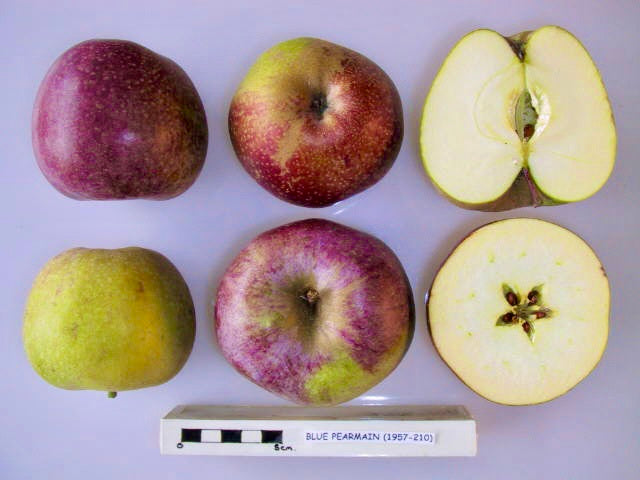
Blue Pearmain Apple
$39.99
Reliable shipping
Flexible returns
Intro
Blue Pearmain is new to us, and all information so far is second-hand. We obtained our scionwood for bench grafting from Tim Makepeace in 2025, and we will update this description as our own trees mature in Montana.
History
Blue Pearmain is an early-19th-century American heirloom from New England. Its exact origin isn’t documented, but it became well known in the Northeast for its distinctive appearance and dependable cropping. It is a cross between Black Oxford and an unknown variety. It was grown widely enough to make it into English collections by the late 1800s and was notable enough to be mentioned by Thoreau in his writings on apples.
Fruit & Flavor
The fruit is large, round, and noticeably weighty, with deep purplish skin covered in a natural bluish bloom—the trait that gives it the name “Blue Pearmain.” The flesh is firm, slightly coarse, and aromatic, with a rich, sweet-to-subacid flavor that lends itself well to fresh eating, late-season desserts, and cider.
This is a late-ripening variety, generally coloring up and finishing in October in cooler regions.
Cold Hardiness & Performance in Montana
On paper, Blue Pearmain is rated as a USDA Zone 4 apple. Zone 4 covers a fairly wide range of minimum temperatures — from –20°F down to –30°F — averaged across a 30-year climate period. Because “Zone 4” blends both 4a and 4b, the practical midpoint of that range is roughly –25°F, but herein lies the limitation with USDA ratings. This rating describes an average annual extreme, not the absolute coldest temperature of an area. A once-in-a-generation cold event can push well below the zone rating, and the USDA map can’t predict how a specific variety will respond when that happens.
To be conservative — and until we observe real-world Montana performance — Blue Pearmain should be able to withstand –35°F as an absolute extreme, given that Black Oxford — one of Blue Pearmain's parents (other unknown) — survived –38°F on Rod McIver's farm in Kalispell, Montana without any winter injury. Therefore, Blue Pearmain will likely do well in most of the valleys of Western Montana, but should not be planted east of the divide in Montana (with the exception of warmer microclimates of the warmer valleys near Billings).
Image courtesy of National Fruit Collection, Brogdale