
Skip to product information
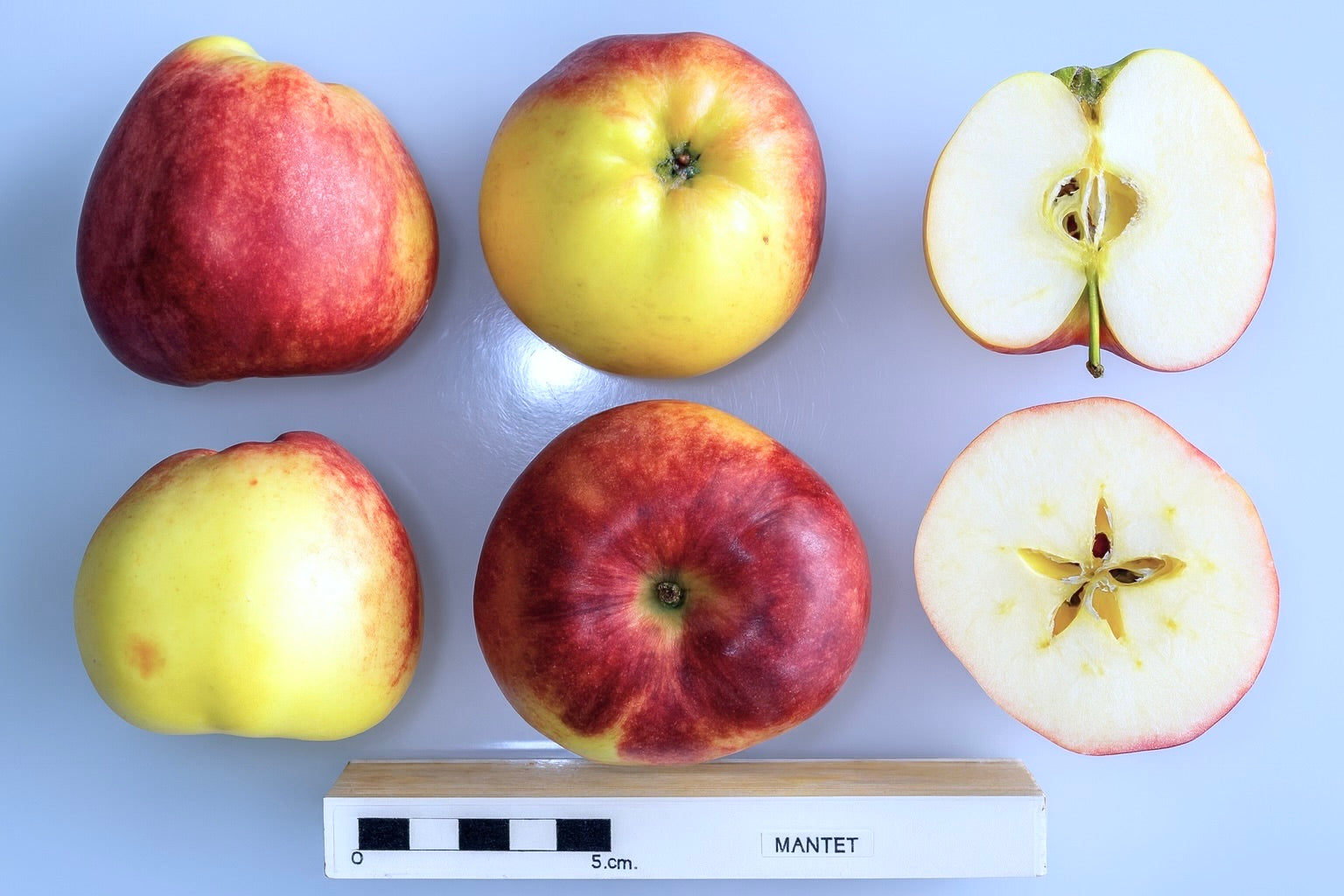
Mantet Apple
$39.99
Reliable shipping
Flexible returns
Overview
Mantet is an early-season dessert apple developed in Manitoba, Canada (Morden) and introduced in 1929. It’s often praised for unusually good flavor for such an early apple. When Luke tried it at Ed Schultz in Summer of 2024, he rated it right up there with Pristine in terms of high quality summer apples. That year it was better than Carroll (another great summer apple), although in 2025, Carroll was better than Mantet (possibly because of our drought).
History & Parentage
Many fruit references describe Mantet as Tetofsky × McIntosh and note it was introduced by the Morden Station in 1929. However, the UK National Fruit Collection lists the parentage as Tetofsky × Unknown. The most rigorous way to state this is: Tetofsky is consistently listed as a parent, while the other parent is variously reported (often McIntosh, sometimes unknown in formal records).
Fruit Quality & Uses
Mantet is tender, fine-textured, juicy, sweet/subacid and aromatic, and is most often used for fresh eating, with additional use for cooking/sauce given its early season and softening nature. As is the case with most summer apples, Mantet is not a good storage apple.
Growth Habit & Spacing
These are on Bud 118 and can be spaced 15 ft. apart. Tighter for a more intense spacing/pruning regiment, or even further for a more lax approach.
Pollination
Not self-fertile—needs another apple nearby with overlapping bloom. Plant with other summer apples such as Carroll, Lodi, Yellow Transparent, Pristine (less hardy), Dearborn's Unknown, Prairie Sensation, Norland, Norkent, Norson, or even some of the earlier season applecrabs such as Rescue, Trailman, Kerr (slightly later), Chestnut, or Martha.
Cold Hardiness
Given Ed Schultz' constant success with Mantet after experiencing two separate winters of -47F, with no winter injury, Mantet is a solid zone 2. Hardy certainly down to -47F, and likely even colder (into the -50Fs). Given its hardiness as a summer apple, it would be a great apple for Alaskan growers in colder parts of the state with a shorter growing season.
Image: Resolution enhanced from a public domain image. The crabapple is unchanged, but some of the surrounding text and numbers may vary.