
Skip to product information
Ure Pear
$39.99
Reliable shipping
Flexible returns
Overview
Ure is a prairie-proven, ultra-cold-hardy pear grown primarily for reliability in harsh climates, with small “Bartlett-type” fruit that can be genuinely enjoyable when picked mature and ripened off the tree. \
Origin and History
Ure was introduced by the Morden, Manitoba Research Station in 1978.
In the Alaska Pioneer Fruit Growers Association write-up, Ure is explicitly described as an interspecific cross of Pyrus ussuriensis × Pyrus communis, and it notes the cultivar was named after Frank Ure, a Canadian pear breeder. (Alaska Pioneer Fruit Growers Association)
Fruit & Uses
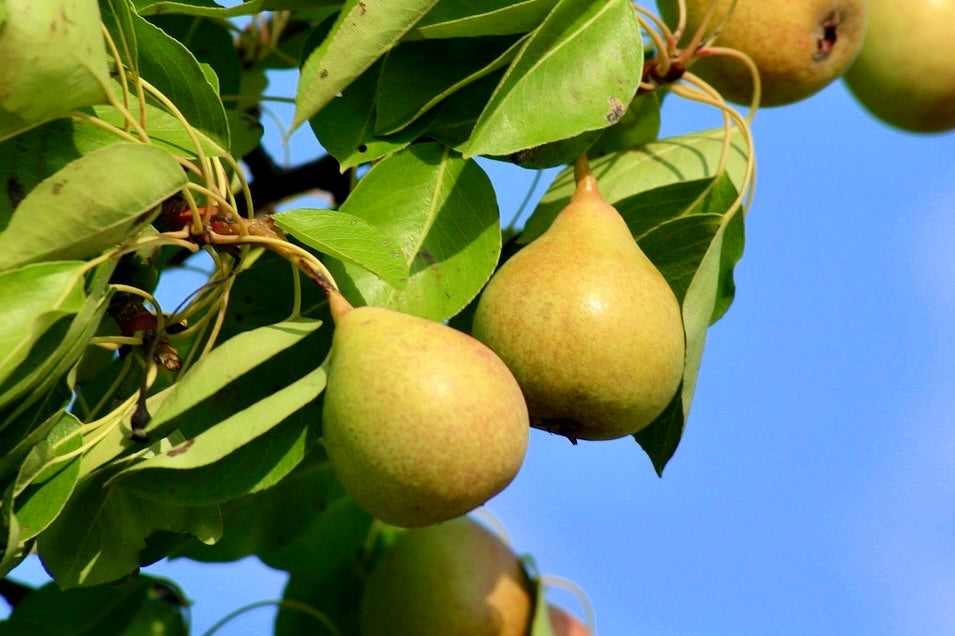
The fruit is relatively small (about 2–2½ inches diameter), nearly round, thin-skinned, with good flavor, no astringency, and a smooth texture on tasted samples.
University of Minnesota Extension describes Ure as producing small “Bartlett-type” fruit with good flavor and lists harvest around mid-August in their recommendations for northern gardens. (University of Minnesota Extension)
Practically: Ure is best treated as an early pear you pick firm and ripen off-tree for best eating quality (and it’s also very serviceable for canning/cooking). (University of Minnesota Extension)
Growth Habit & Spacing
Ure is a smaller tree (to ~15 feet), however, given that we offer it on full size Ussurian pear rootstock, which generally pushes trees toward a larger, more vigorous, standard form the best way to reconcile this: expect Ure to be “moderate-sized for a hardy pear,” but don’t plan on it behaving like a tight semi-dwarf just because the cultivar can be compact in some settings. A safe long-term spacing band for Ure on Ussurian rootstock is about 16–20 feet (closer if you’ll prune annually to keep the canopy narrow, wider on rich soils or if you want minimal pruning).
Pollination
UMN Extension states that in areas too cold for other pears, Ure can be grown with Golden Spice for pollen. (University of Minnesota Extension), although Summercrisp is also a known pollenizer for Ure as well.
Cold Hardiness
The APFGA notes report that Clair Lammers had good survival of -46°F with his Ure in Fairbanks during the winter of 1989–90. (Alaska Pioneer Fruit Growers Association)
Separately, multiple nursery references rate Ure around -40°F (or roughly zone-3 class hardiness), but those are best treated as generalized ratings rather than a single verified event record. (thetreefarm.com)
So the best evidence-based way to say it is: Ure has at least one documented report of surviving -46°F, and it is widely treated in cold-climate guidance as one of the hardiest named pears commonly available that doesn't come from the South Ural Research Institute of Horticulture and Potato Growing. (Alaska Pioneer Fruit Growers Association)