
Skip to product information


John's Elderberry (Bundle of 2) | Spring 2027
$59.99
Reliable shipping
Flexible returns
Ripening
Will it finish before your first hard freeze?
Check it on the Ripening Map (opens in a new tab)At a glance: John's Elderberry is an elderberry shrub rated hardy to zone 3 in our ratings (winters to -40°F), partially self-fertile, so a second variety nearby makes crops more dependable, and it ripens about Aug 8 to Aug 20 in Missoula (our Missoula estimate).
| Hardy to | Zone 3 to 8. A bare number means the whole of zone 3, colder half included (winters to -40°F). Our notes have it taking -38°F. Find your zone with our cold hardiness calculator. |
|---|---|
| Pollination | Partially Self-Fertile. Bloom group 4 of 7 (mid), early summer here. John's sets some fruit alone, but plant a different elderberry such as Adams nearby for a better crop. Two John's plants are the same clone. Elderberries bloom in early summer, long after apples and plums. Nearby varieties that can boost the crop: Adam's Elderberry (Bundle of 2), Elderberry, American (Bundle of 3), Ranch Elderberry (Bundle of 2). Bloom group is our estimate from the variety's origin and relatives. Pollination Charts. |
| Ripens | About Aug 8 to Aug 20 in Missoula (a Missoula estimate from published sources). Real years swing about a week either way. See the date for your town. |
| Spacing | Plant 6 to 10 ft apart. |
| Good for | Juice and sweet cider (9/10), jams and jellies (8/10), wine (8/10), feeding wildlife (8/10), sauce and butter (8/10), pies and baking (7/10). Scores are our own 1 to 10 ratings; 8 and up makes our Best Of lists. |
| Deer | Sometimes damaged by deer. |
| What you get | Bare root. Shipped or picked up in Missoula in spring, roots wrapped in moist sawdust. Guaranteed to bud out. |
Overview
John’s Elderberry (commonly listed as Johns) is a cold-hardy American elderberry (Sambucus canadensis) selected in eastern Canada and long valued by northern growers for its reliability, productivity, and fruit quality. It has been widely planted in cold regions of the U.S. and Canada and is often used as a benchmark cultivar when evaluating elderberry performance in short-season, cold-winter climates. John's has done consistently well for us in Western Montana.
Fruit Quality & Uses
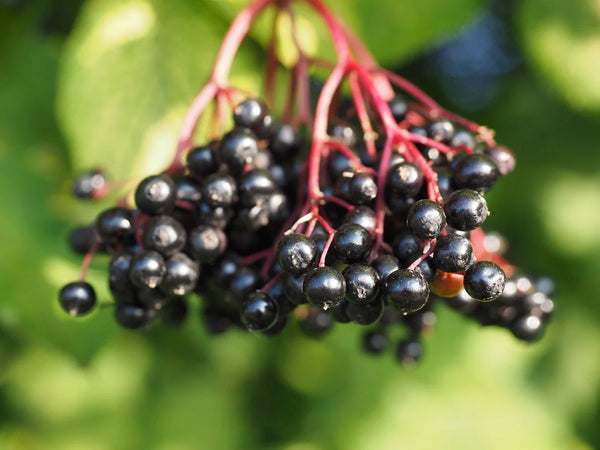
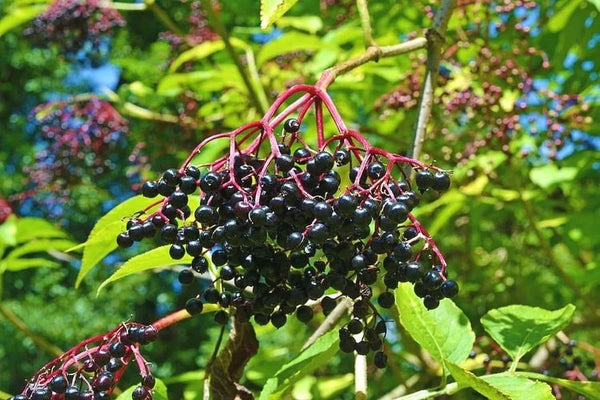
John’s produces large clusters of dark purple to nearly black berries with good juice content. Like most American elderberries, the fruit is not intended for fresh eating but excels when processed. It is widely used for syrups, juice, wine, tinctures, jams, and other medicinal or culinary preparations. John’s is often noted for good flavor concentration and high yields, making it especially useful for processing at scale.
Growth Habit & Spacing
John’s Elderberry grows as a vigorous, multi-stemmed shrub, typically reaching 6–8 feet tall and wide under good conditions. Plants spread gradually from the crown and respond well to coppicing or renewal pruning. A practical spacing is 6–10 feet apart, depending on whether plants are managed as individual shrubs or in a hedgerow system. Regular pruning encourages strong new growth and higher fruit production, as elderberries fruit on new wood.
Cold Hardiness
John’s Elderberry is consistently described as extremely cold hardy, with many extension and nursery references placing it solidly in USDA Hardiness Zone 3. This matches our experience. 5 year old John's had survived -38°F in Corvallis, MT on 1/13/24. Literature cites it is hardy down to -40°F, although it may even be hardier than this because even when top growth is damaged in severe winters, plants typically regrow vigorously from the crown in spring, which is a key reason elderberries perform so reliably in very cold climates.
Pollination
Elderberries are partially self-fertile, but cross-pollination significantly improves fruit set and yield. Planting John’s alongside another American elderberry cultivar (such as Adams or our Black Elderberry) is strongly recommended for best performance.
Other Notable Characteristics
John’s is frequently highlighted for its combination of cold hardiness, heavy bearing, and suitability for medicinal use. Like all elderberries, fruit must be cooked before consumption. The shrub also offers ecological value, with abundant spring flowers for pollinators and late-season fruit for birds.
Plant Size & Root Health
These shrubs are 1–2 feet tall and have excellent root systems, with lots of fine root hairs to help them establish quickly.
Questions we get about John's Elderberry
Does John's Elderberry need a pollenizer?
It helps. John's Elderberry is partially self-fertile, so it can set some fruit alone, but a second variety nearby makes crops more dependable. John's sets some fruit alone, but plant a different elderberry such as Adams nearby for a better crop. Two John's plants are the same clone. Elderberries bloom in early summer, long after apples and plums. Partners we carry include Adam's Elderberry (Bundle of 2), Elderberry, American (Bundle of 3), Ranch Elderberry (Bundle of 2).
How cold hardy is John's Elderberry?
We rate John's Elderberry hardy to zone 3, which means winters down to about -40°F. Our notes have it taking -38°F. Our ratings come from real winters at our two Montana sites and from trusted growers across the North, not from a catalog average.
When does John's Elderberry ripen?
About Aug 8 to Aug 20 in Missoula, Montana (an estimate built from published sources and our climate). Warmer places run earlier and cooler places later; our ripening map converts the date to your town.
What is John's Elderberry good for?
Our top use scores for John's Elderberry are juice and sweet cider (9/10), jams and jellies (8/10), wine (8/10), feeding wildlife (8/10). Anything scored 8 or higher makes our Best Of lists.
Will deer eat John's Elderberry?
Sometimes. Deer browse John's Elderberry now and then, so protect young plants where deer pressure is high.
What arrives, and when does John's Elderberry ship?
A dormant bare-root plant, roots wrapped in moist sawdust with a vapor barrier, shipped or picked up in Missoula in spring. We guarantee our plants bud out. Stone fruits can be slow, so if one still has not budded out by August 15, write to us and we credit you for the following spring.
Pollination partners
Partners for a bigger John's Elderberry crop
John's Elderberry sets some fruit on its own, but a lot more with a partner. Every tree below blooms at the same time and has pollen that works for it.
Bloom group
4 of 7 (Mid)
Pollination
Partly self-fertile
Pollen
Good pollenizer
-
 Sold out
Ranch Elderberry(Bundle of 2)
Sold out
Ranch Elderberry(Bundle of 2)
See every pairing on the Pollination Charts
John's Elderberry's bloom group is our best estimate. Watch it bloom and tell us what you see.