
Skip to product information
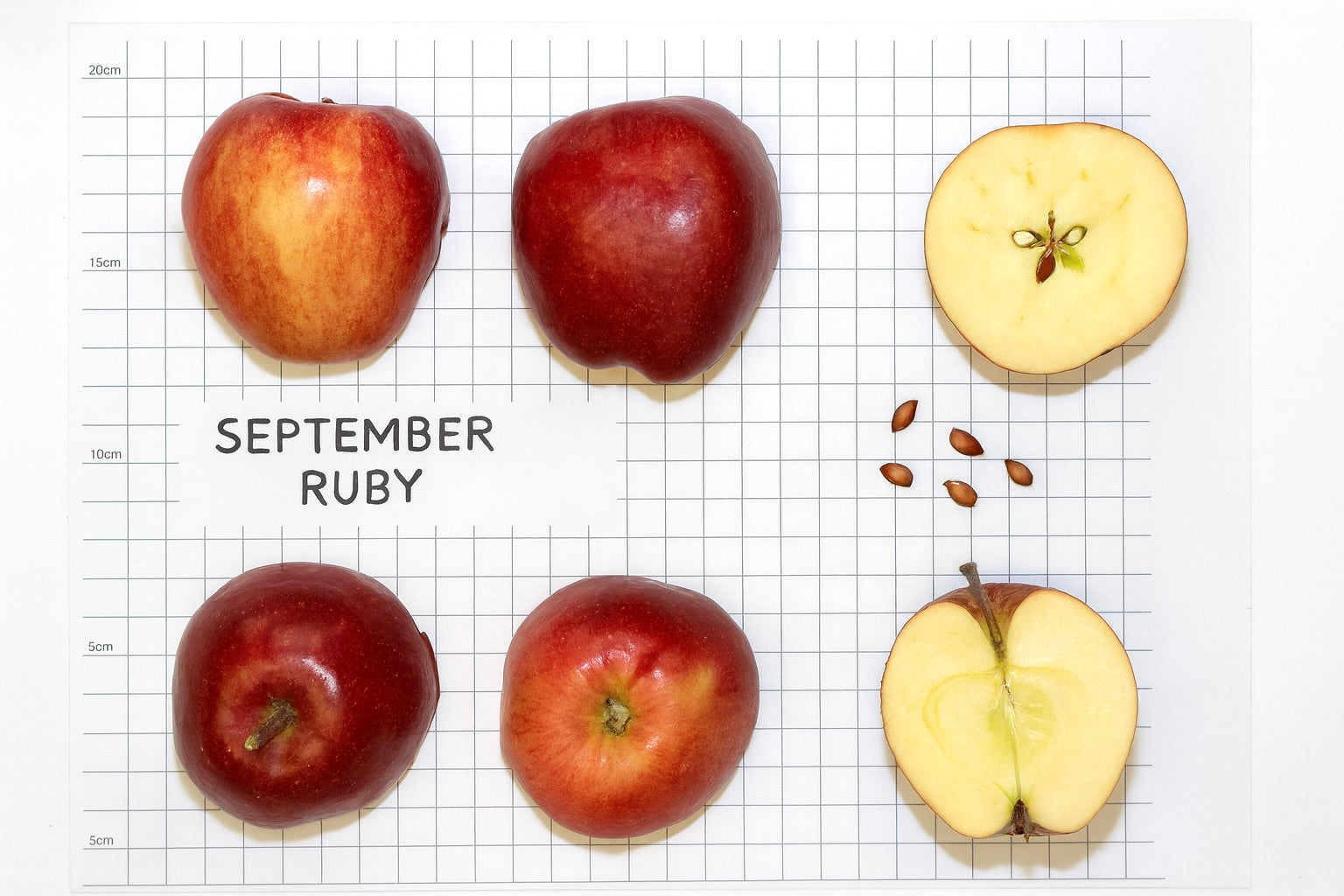
September Ruby Apple
$24.99
Reliable shipping
Flexible returns
Overview
September Ruby is an extremely cold-hardy prairie apple released for northern climates where winter survival and dependable cropping matter more than perfect “dessert apple” aesthetics. It produces medium-sized, bright red fruit over a light green base, with crisp flesh and a distinctly tart-leaning, refreshing eating quality. In prairie and subarctic-style testing and grower use, it is consistently positioned as a versatile apple for fresh eating, cooking, juicing, and surprisingly strong keeping for an early-to-mid September ripener.
Origin & History
September Ruby was developed within Canada’s prairie hardy-fruit breeding efforts. It originated from the Morden Research Station (Agriculture Canada) through work led by C. R. Ure for the Prairie Fruit Breeding Cooperative. It was selected as #6021, tested as PF36, and released in 1986.
Its documented lineage is Rescue × Haralson, a cross that aligns with the breeding goal of combining early-season reliability and cold hardiness with improved fruit quality for very cold regions.
Fruit & Uses
Fruit is typically described as medium-sized, around 6–7 cm (roughly 2½ inches) in diameter, round-oblate (somewhat flattened), often with noticeable ribbing. Skin is moderately thick with a light green base striped and blushed bright to dark red, and it may occasionally become fully red.
The flesh is greenish, crisp, and moderately acid. In plain eating terms, the flavor is commonly described as “a bit tart” while still being considered a great eating apple, with strong crunch and a clean, straightforward apple character rather than a complex or perfumed profile. It is rated very good for fresh eating, and it is also consistently recommended for cooking and especially for juicing.
One important nuance from prairie cultivar notes is that green-fleshed apples can read as slightly bitter to some individuals. That does not mean the apple is “bitter” as a rule; it means a minority of tasters may perceive a slight bitter edge.
In terms of storage, September Ruby is notably a good keeper for its season, with documented storage performance up to about 16 weeks under proper cold storage.
Growth Habit
The tree is moderately vigorous with an upright-spreading habit, fair to good branching, and annual productivity. It is commonly described as reliably productive in cold regions once established, fitting the overall “hardy prairie workhorse” profile that these breeding programs targeted.
Spacing
We offer September Ruby on Antonovka full-size rootstock.
As a full-size rootstock, Antonovka will ultimately produce a large, vigorous tree. In most orchard settings, practical spacing is generally in the range of about 18–25 feet between trees depending on soil vigor, irrigation, pruning/training intensity, and whether you’re managing for equipment access. A tighter spacing can work if you commit to canopy management and want earlier orchard “closure,” while wider spacing is appropriate on fertile ground or where you want large, low-maintenance trees over the long haul. For a rigorous pruning regiment, trees could even be planted closer than 18 ft. apart. If the growing season is longer than ours in MT, and the soils are deeper, one likely will need to summer prune as well Spring prune, whereas colder climate folks could likely get away with just Spring pruning at 15 ft spacing.
Pollination
September Ruby should be treated as not self-fertile for reliable production and should be planted with a different, compatible apple or crabapple that overlaps bloom for cross-pollination. Examples we offer include Dolgo Crabapple, Haralson, Rescue, Dearborn's Unknown, Prairie Sensation, Norkent, Norda, Norson, Kerr, Chestnut. and many others.
Cold Hardiness
Prairie cultivar documentation places September Ruby in the most cold-adapted class of apples commonly grown in North America, with hardiness noted to zone 2a in its original program descriptions.
On-the-ground, the tree has performed very well for Ed Schultz in Gallatin Gateway and showed no winter injury after repeated winters that saw −47°F. That observation is specific to that site and management, but it is consistent with September Ruby’s documented role as a top-tier zone 2a cold-climate apple. May even survive in protected zone 1 sites, although this is hypothetical.
Other Notes
September Ruby is often nicknamed “King of the North” in the hardy-fruit world, reflecting the way growers talk about its winter survival and annual bearing.
Listed as moderately resistant to fire blight, which is notable for a very hardy apple type, but it should still be managed like any apple in a fire blight region (balanced nutrition, avoid excessive vigor, prompt removal of strikes if they occur). Some cultivar references also note susceptibility to mildew, so standard airflow and canopy management remains worthwhile.
Image: Resolution enhanced from a public domain image. The apple is unchanged, but some of the surrounding text and numbers may vary.