
Skip to product information


Yakima Plum
$29.99
Reliable shipping
Flexible returns
Pollination
Needs a partner
Bloom group
4 of 7 (Mid)
Ripening
Will it finish before your first hard freeze?
Check it on the Ripening Map (opens in a new tab)At a glance: Yakima Plum is a plum tree rated hardy to zone 3 in our ratings (winters to -40°F), and not self-fertile, so it needs a different variety nearby as a pollenizer (bloom group 4 of 7, mid for a European plum).
| Hardy to | Zone 3 to 8. A bare number means the whole of zone 3, colder half included (winters to -40°F). Find your zone with our cold hardiness calculator. |
|---|---|
| Pollination | Needs Cross-Pollination. Bloom group 4 of 7 (mid), mid spring here. Yakima needs another European plum such as Stanley, Italian or Mount Royal to fruit. Hybrid plums, Native American plum and Prairie Red will not pollenize it. Good partners we carry: Stanley Plum, Mount Royal Plum, Italian Plum, Early Italian Plum and 6 more. Bloom group is our estimate from the variety's origin and relatives. Plum Pollination Map. |
| Rootstock and size | Krymsk 86: full size. Plant about 15 ft apart. Our rootstock guide. |
| Good for | Fresh eating (8/10), canning and freezing (7/10), jams and jellies (6/10). Scores are our own 1 to 10 ratings; 8 and up makes our Best Of lists. |
| Deer | A deer favorite. Fence it or cage it. |
| What you get | Bare root, 1-2 ft or 2-4 ft. Shipped or picked up in Missoula in spring, roots wrapped in moist sawdust. Guaranteed to bud out. |
Overview
Yakima is one of the most cold hardy of the European plums. The are the most massive plums we've seen growing in Montana. It occupies a valuable niche for northern orchards: a true European plum with dessert-quality fruit that has been successfully grown in regions where many standard European plums struggle.
Origin and history
The precise origin and parentage of Yakima are not documented in verifiable primary sources. While Yakima appears in multiple nursery catalogs and grower references, no authoritative breeding record or confirmed parentage has been published.
Fruit & Uses
Yakima produces notably large plums for a European type. The skin is a mahogany red to pinkish-violet with flesh ranging from yellow to amber. The fruit is freestone, firm, sweet, and very good quality. It is well suited to fresh eating and also performs well for traditional European plum uses such as drying and preserving. Yakima can ripen over an extended window of roughly two to three weeks, which allows for staggered harvest rather than a single compressed picking period.
Growth Habit
Yakima grows with an upright, vigorous habit typical of European plums. With standard pruning practices, it can be trained into either an open-center or modified central leader form, prioritizing light penetration and renewal of fruiting wood.
Spacing
We offer Yakima on Krymsk 86. Krymsk 86 is considered a full size stone fruit rootstock. A practical spacing range for this rootstock is approximately 15 feet between trees, depending on pruning intensity, desired canopy size, and site vigor. Wider spacing supports airflow and ease of maintenance; tighter spacing requires more active canopy management.
Pollination
Yakima is not reliably self-fertile and requires cross-pollination from another European plum.
We offer several European plums that can serve as potential pollenizers, including: Italian, Early Italian, Stanley, Mount Royal, and Northern Blue. Asian x American hybrid plums will not work as pollenizers for Yakima, not will native plum or prairie red.
Cold hardiness
Yakima is fairly cold hardy, and is very hardy to a European plum. It survived our friend James Sapp's -29F in Missoula without any winter injury. Purvis notes that it is hardy to -40F and lists it as a zone 3. Whether Yakima can survive in the colder valleys west of the divide in MT we do not have the data, but any area that sees below -40F would have to plant with caution, i.e. certainly avoid depressions/frost pooling areas, make sure there is adequate airflow, and possibly even plant near structures for thermal buffering. Hardy to zone 3.
Other Notes
Yakima stands out because it delivers genuinely large, freestone European plums in climates where such fruit is often difficult to achieve. The extended ripening period reported by growers is an especially useful trait for home orchards and small-scale plantings.
No cultivar-specific disease resistance has been documented for Yakima in verifiable sources. As with most European plums, long-term health depends primarily on site selection, spacing, airflow, pruning, and orchard sanitation rather than inherent resistance traits.
Questions we get about Yakima Plum
Does Yakima Plum need a pollenizer?
Yes. Yakima Plum needs pollen from a different variety that blooms at about the same time. Yakima needs another European plum such as Stanley, Italian or Mount Royal to fruit. Hybrid plums, Native American plum and Prairie Red will not pollenize it. Partners we carry include Stanley Plum, Mount Royal Plum, Italian Plum.
How cold hardy is Yakima Plum?
We rate Yakima Plum hardy to zone 3, which means winters down to about -40°F. Our ratings come from real winters at our two Montana sites and from trusted growers across the North, not from a catalog average.
How big does Yakima Plum get?
We graft Yakima Plum onto Krymsk 86 (full size). Plant about 15 ft apart.
What is Yakima Plum good for?
Our top use scores for Yakima Plum are fresh eating (8/10), canning and freezing (7/10), jams and jellies (6/10). Anything scored 8 or higher makes our Best Of lists.
Will deer eat Yakima Plum?
Yes, deer love it. Protect Yakima Plum with a fence or a cage, especially while it is young.
What arrives, and when does Yakima Plum ship?
A dormant bare-root plant, roots wrapped in moist sawdust with a vapor barrier, shipped or picked up in Missoula in spring. Sizes offered: 1-2 ft or 2-4 ft. We guarantee our plants bud out. Stone fruits can be slow, so if one still has not budded out by August 15, write to us and we credit you for the following spring.
Pollination partners
Trees that will pollenize Yakima Plum
Yakima Plum needs a different European plum nearby to set fruit. Every tree below blooms at the same time and has pollen that works for it. Plant partners within about 100 feet.
Bloom group
4 of 7 (Mid)
Pollination
Needs a partner
Pollen
Good pollenizer
-
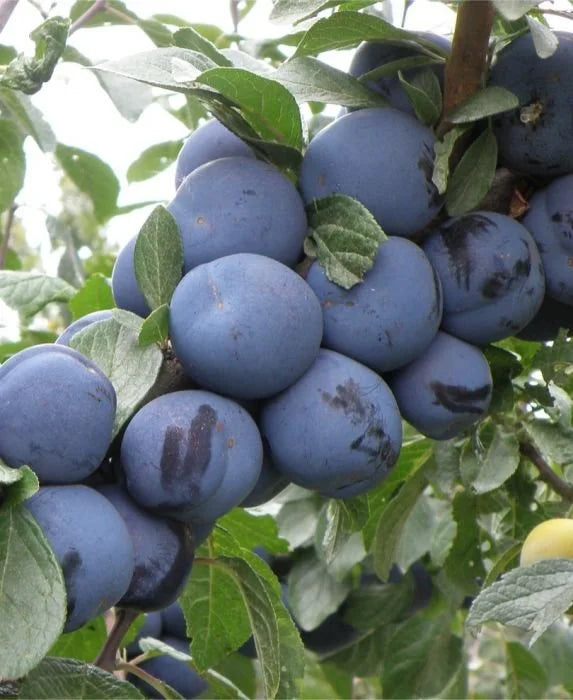 Mount Royal Plum(Spring 2027)
From $49.99
Mount Royal Plum(Spring 2027)
From $49.99
-
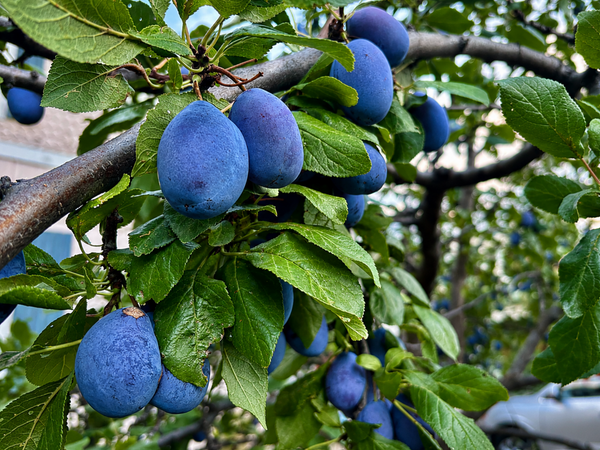 Italian Plum(Spring 2027)
From $74.99
Italian Plum(Spring 2027)
From $74.99
-
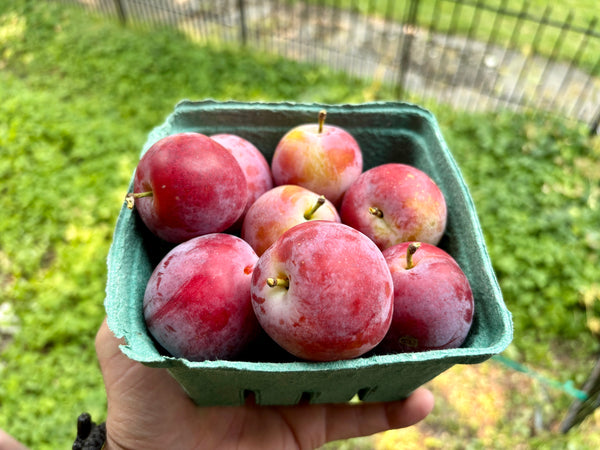 Deluge Plum(Spring 2027)
From $59.99
Deluge Plum(Spring 2027)
From $59.99
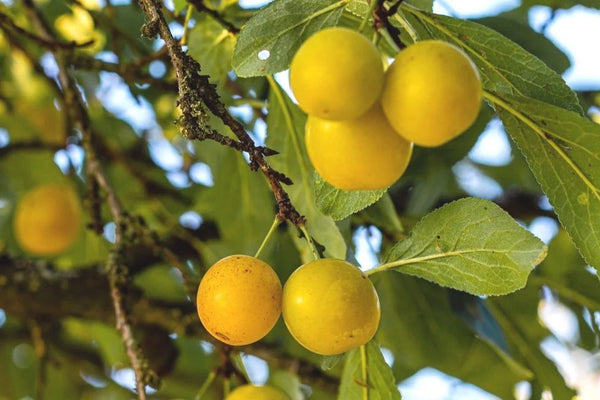
See every pairing on the Plum Pollination Map
Yakima Plum's bloom group is our best estimate. Watch it bloom and tell us what you see.