
Skip to product information


Purvis English Walnut Seedling (Bundle of 2)
$49.99
Reliable shipping
Flexible returns
Ripening
Will it finish before your first hard freeze?
Check it on the Ripening Map (opens in a new tab)At a glance: Purvis English Walnut Seedling is a walnut tree rated hardy to zone 4 in our ratings (winters to -30°F), and wind-pollinated with staggered male and female bloom, so plant two different trees.
| Hardy to | Zone 4 to 7. A bare number means the whole of zone 4, colder half included (winters to -30°F). Find your zone with our cold hardiness calculator. |
|---|---|
| Pollination | Heterodichogamous - Plant Two Different Trees. Bloom group 4 of 7 (mid), late spring to early summer here. English walnuts are wind-pollinated and not reliable alone because each tree sheds pollen and opens female flowers at different times, so plant both seedlings, and a third English walnut such as Purvis Hardy or Ultra Northern makes a crop more certain. Good partners we carry: Purvis Hardy English Walnut (Bundle of 2), Ultra Northern English Walnut (Bundle of 2), Buartblack Walnut (Bundle of 2), Black Walnut (Bundle of 3). Bloom group is our estimate from the variety's origin and relatives. Walnut & Heartnut Pollination Chart. |
| Good for | Pies and baking (7/10), edible nuts (7/10). Scores are our own 1 to 10 ratings; 8 and up makes our Best Of lists. |
| Deer | A deer favorite. Fence it or cage it. |
| What you get | Bare root, 1-2 ft. Shipped or picked up in Missoula in spring, roots wrapped in moist sawdust. Guaranteed to bud out. |
Overview
These are seed-grown English walnut (Juglans regia) trees raised from nuts collected on Bob Purvis’ farm in Homedale, Idaho in the fall of 2023. The seed was stratified over winter and grown in pots through the 2024 and 2025 seasons. The walnuts originate from a selected tree bred by Bob’s neighbor and avid fruit grower, Garfield Schultz, making these seedlings derived from locally adapted, intentionally selected material rather than random wild stock.
History & Origin
The mother tree from which these seeds were collected was selected for nut quality and performance in a cold-interior site relative to most English walnuts. While these are seedlings and therefore genetically variable, they trace back to a known, intentionally bred tree rather than an unknown or feral source.
Nut Quality & Uses
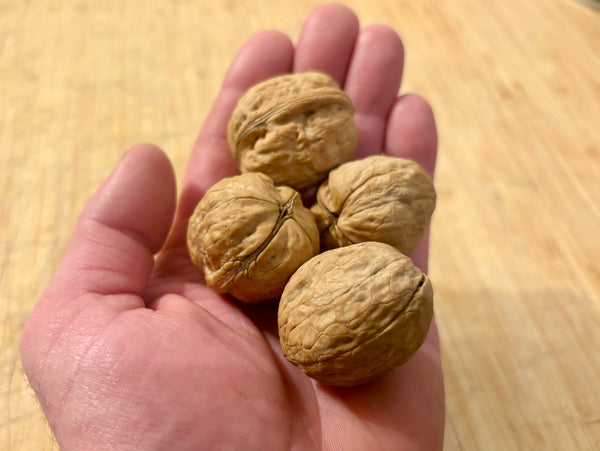
The walnuts have very good eating quality, with a sweet, clean, nutty flavor and a crunchy texture. One notable trait is the lack of bitterness—there is little to no bitter aftertaste, which is not always the case with English walnuts, especially in colder climates. These are well suited for fresh eating, baking, and general kitchen use.
Cold Hardiness
The mother tree has withstood winter lows of −20°F without any winter injury. Beyond that, cold tolerance has not yet been fully tested. Based on the performance of the mother tree and regional context, it is reasonable to suspect tolerance to at least −25°F, and possibly −30°F, though this has not been confirmed. Because these trees are seed-grown and still young, true cold limits remain uncertain and should not be considered authoritative at this stage. For now, these walnuts are conservatively listed as Zone 5 English walnuts, with the possibility that they may ultimately prove suitable for Zone 4 conditions pending further observation.
Notes on Seed-Grown Material
Because these trees are grown from seed, variation in growth habit, cold tolerance, and nut characteristics should be expected. This makes them especially interesting for growers interested in selection, adaptation, and long-term breeding potential, but they should be planted with the understanding that performance will vary from tree to tree until proven otherwise through time and exposure.
These Walnuts are all 1-2 ft.
Questions we get about Purvis English Walnut Seedling
How cold hardy is Purvis English Walnut Seedling?
We rate Purvis English Walnut Seedling hardy to zone 4, which means winters down to about -30°F. Our ratings come from real winters at our two Montana sites and from trusted growers across the North, not from a catalog average.
What is Purvis English Walnut Seedling good for?
Our top use scores for Purvis English Walnut Seedling are pies and baking (7/10), edible nuts (7/10).
Will deer eat Purvis English Walnut Seedling?
Yes, deer love it. Protect Purvis English Walnut Seedling with a fence or a cage, especially while it is young.
What arrives, and when does Purvis English Walnut Seedling ship?
A dormant bare-root plant, roots wrapped in moist sawdust with a vapor barrier, shipped or picked up in Missoula in spring. Sizes offered: 1-2 ft. We guarantee our plants bud out. Stone fruits can be slow, so if one still has not budded out by August 15, write to us and we credit you for the following spring.
Pollination partners
Trees that will pollenize Purvis English Walnut Seedling
English walnuts are wind-pollinated and not reliable alone because each tree sheds pollen and opens female flowers at different times, so plant both seedlings, and a third English walnut such as Purvis Hardy or Ultra Northern makes a crop more certain.
Bloom group
4 of 7 (Mid)
Pollination
Plant two or more
Pollen
Good pollenizer
-
 Sold out
Buartblack Walnut(Bundle of 2)
Sold out
Buartblack Walnut(Bundle of 2)
See every pairing on the Walnut & Heartnut Pollination Chart
Purvis English Walnut Seedling's bloom group is our best estimate. Watch it bloom and tell us what you see.