
Skip to product information


SnowCzar Almond
$39.99
Reliable shipping
Flexible returns
Ripening
Will it finish before your first hard freeze?
Check it on the Ripening Map (opens in a new tab)At a glance: SnowCzar Almond is an almond tree rated hardy to zone 4 in our ratings (winters to -30°F), and not self-fertile, so it needs a different variety nearby as a pollenizer.
| Hardy to | Zone 4 to 8. A bare number means the whole of zone 4, colder half included (winters to -30°F). Our notes have it taking -25°F. Find your zone with our cold hardiness calculator. |
|---|---|
| Pollination | Needs Cross-Pollination. Bloom group 4 of 7 (mid), earliest spring here. Plant a second, different almond nearby as a pollenizer. SnowCzar is a seedling of a self-fertile parent, but it has not been shown to set nuts on its own pollen. Good partners we carry: Javid's Iranian Almond Seedling. Bloom group is our estimate from the variety's origin and relatives. Pollination Charts. |
| Rootstock and size | Manchurian: full size, about 15 to 20 ft tall unpruned. The hardiest apricot root there is. Siberian C: semi-standard, about 12 to 17 ft tall unpruned. Our rootstock guide. |
| Good for | Edible nuts (6/10). Scores are our own 1 to 10 ratings; 8 and up makes our Best Of lists. |
| What you get | Bare root, ± 2 ft or 4-5 ft or 5-6 ft. Shipped or picked up in Missoula in spring, roots wrapped in moist sawdust. Guaranteed to bud out. |
Introducing SnowCzar: A Cold-Hardy Almond 5 Years in the Making
This almond has been five years in the making—although that's not long relative to typical research breeding operations.
Disclaimer: This variety is still in trial, and we make no guarantees. That said, read on if you're interested in our efforts to breed almonds for cold climates.
The Breeding Journey
We began with 800 seeds. Through a specific “Antifreeze Protein Selection” process developed by Luke (see below), 40 seedlings survived. After two years, we culled 32 of them, leaving us with just 8 elite selections. SnowCzar comes from this final group.
Antifreeze Protein Selection Process
Our cold hardiness selection process is based on Luke’s “Antifreeze Protein Selection” method. Here's how it works:
-
Seed Selection: 800 seeds were deliberately frozen and thawed during cold stratification.
-
Initial Survivors: The 40 seeds that germinated were planted.
-
Second-Year Selection: During the following winter, trees were left unprotected in pots to simulate natural freeze-thaw cycles.
-
Final Culling: We selected only those seedlings that exhibited strong antifreeze protein secretion, similar to what we see in native cold-hardy species like chokecherry and serviceberry.
After culling at both the seed and juvenile stages, the remaining almonds have proven to be the strongest and most cold-hardy survivors.
SnowCzar's Ancestry
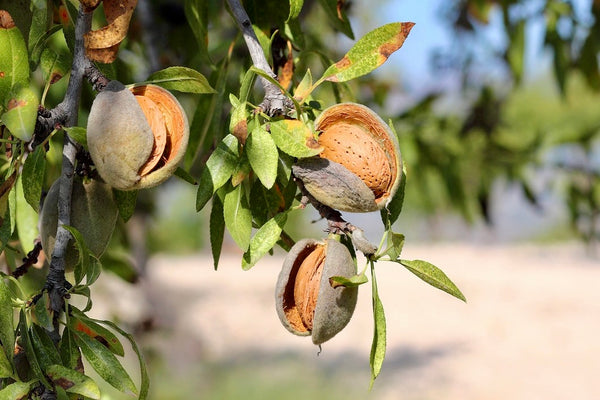
SnowCzar descends from NC1, a seedling selection of the Titan almond developed by Doug Collins in Ontario, Canada. NC1 produces average-sized nuts in well-sealed shells. It is self-fertile, with reportedly good disease resistance and dependability.
Cold Hardiness Potential
We believe SnowCzar is hardy to -25°F, and potentially even -30°F or lower, as there was no tip dieback observed at -25°F.
Rootstock and Tree Sizes
SnowCzar is grafted onto Manchurian Apricot, a rootstock significantly hardier than almond itself, as well as Siberian C Peach, which is also hardier than the almond. Manchurian is known to tolerate temperatures well into the -40F range whereas Siberian C has survived sub -35F temps (the only peach known to survive such temps).
Questions we get about SnowCzar Almond
Does SnowCzar Almond need a pollenizer?
Yes. SnowCzar Almond needs pollen from a different variety that blooms at about the same time. Plant a second, different almond nearby as a pollenizer. SnowCzar is a seedling of a self-fertile parent, but it has not been shown to set nuts on its own pollen. Partners we carry include Javid's Iranian Almond Seedling.
How cold hardy is SnowCzar Almond?
We rate SnowCzar Almond hardy to zone 4, which means winters down to about -30°F. Our notes have it taking -25°F. Our ratings come from real winters at our two Montana sites and from trusted growers across the North, not from a catalog average.
How big does SnowCzar Almond get?
We graft SnowCzar Almond onto Manchurian (full size), which makes a tree roughly 15 to 20 ft tall if you never prune it. Some sizes are on Siberian C.
What is SnowCzar Almond good for?
Our top use scores for SnowCzar Almond are edible nuts (6/10).
What arrives, and when does SnowCzar Almond ship?
A dormant bare-root plant, roots wrapped in moist sawdust with a vapor barrier, shipped or picked up in Missoula in spring. Sizes offered: ± 2 ft or 4-5 ft or 5-6 ft. We guarantee our plants bud out. Stone fruits can be slow, so if one still has not budded out by August 15, write to us and we credit you for the following spring.
Pollination partners
Trees that will pollenize SnowCzar Almond
SnowCzar Almond needs a different variety nearby to set fruit. Every tree below blooms at the same time and has pollen that works for it. Plant partners within about 100 feet.
Bloom group
4 of 7 (Mid)
Pollination
Needs a partner
Pollen
Good pollenizer
-
 Sold out
Javid's Iranian Almond Seedling
Sold out
Javid's Iranian Almond Seedling
See every pairing on the Pollination Charts
SnowCzar Almond's bloom group is our best estimate. Watch it bloom and tell us what you see.