
Skip to product information


Javid's Iranian Almond Seedling
$34.99
Reliable shipping
Flexible returns
Ripening
Will it finish before your first hard freeze?
Check it on the Ripening Map (opens in a new tab)At a glance: Javid's Iranian Almond Seedling is an almond tree rated hardy to zone 5 in our ratings (winters to -20°F), and not self-fertile, so it needs a different variety nearby as a pollenizer.
| Hardy to | Zone 5 to 8. A bare number means the whole of zone 5, colder half included (winters to -20°F). Find your zone with our cold hardiness calculator. |
|---|---|
| Pollination | Needs Cross-Pollination. Bloom group 5 of 7 (mid-late), earliest spring here. Plant at least two of these seedlings, or another almond such as SnowCzar, so each tree has a pollenizer. Each seedling is genetically different, so two seedlings can usually serve as pollenizers for each other. Good partners we carry: SnowCzar Almond. Bloom group is our estimate from the variety's origin and relatives. Pollination Charts. |
| Good for | Edible nuts (6/10). Scores are our own 1 to 10 ratings; 8 and up makes our Best Of lists. |
| What you get | Bare root, 2-3 ft or 3-5 ft. Shipped or picked up in Missoula in spring, roots wrapped in moist sawdust. Guaranteed to bud out. |
Overview
Javid’s Iranian Almond is an almond selection originating from Iran, a region with a long history of almond cultivation and genetic diversity. This selection reflects that background, coming from a climate with cold winters, hot summers, and strong seasonal contrasts. While almonds are not typically considered cold-climate crops, certain Iranian landrace types have shown greater winter hardiness and later bloom tendencies than standard commercial almonds. This description is based on what is known from almond literature and regional context rather than long-term local experience.
Fruit Quality & Uses
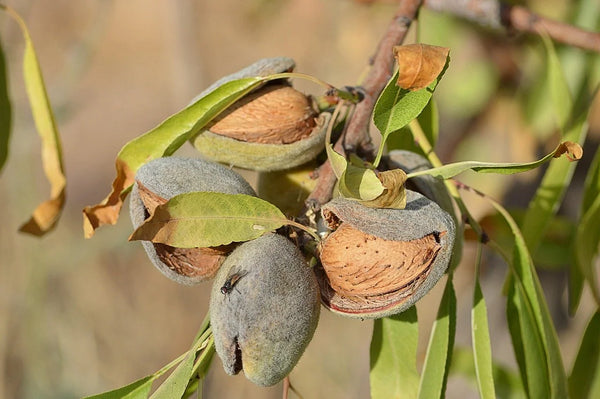
Javid’s Iranian Almond produces true almond nuts intended for kernel use rather than ornamental value. From what is generally known about Iranian almond types, kernels are typically well flavored and suited for fresh eating, roasting, and culinary use. Because this material comes from seed-derived or regionally selected genetics rather than a modern uniform cultivar, kernel size, shell hardness, and flavor can show some variability.
Growth Habit & Spacing
Almonds grow as medium-sized trees with an upright to spreading habit, similar in form to peaches. Trees typically require 12–16 feet of spacing to allow for canopy development, airflow, and light penetration. Annual pruning helps maintain structure and manage vigor. As with all almonds, site selection is critical, particularly avoiding frost pockets and poorly drained soils.
Cold Hardiness
There is no published, cultivar-specific minimum extreme winter temperature for Javid’s Iranian Almond. In general, almonds are far less cold-hardy than peaches or apricots, with many commercial types suffering wood injury below about −10°F to −15°F. However, Iranian almond landraces are often cited as among the more cold-tolerant within the species, having evolved under continental conditions with real winter cold.
Based on available information, Javid’s Iranian Almond should be considered experimental in cold climates, likely best suited to protected sites and milder zones. For context, when Missoula experienced -27°F on 1/13/24, Javi'd actually survived this but had some serious tip injury. Our Snowczar almond that we introduced, however, had zero tip dieback even as 2 year old seedlings. Winter survival, bloom timing, and crop reliability in Montana will need to be confirmed through observation rather than assumed.
Pollination
Most almonds benefit from cross-pollination. For reliable nut set, planting with another compatible almond that blooms at a similar time is recommended. Pollinator activity during bloom is essential, especially in cooler spring conditions. Will cross with Snowczar.
Other Notable Characteristics
The primary value of Javid’s Iranian Almond lies in its genetic interest rather than guaranteed performance. As a selection tied to a region known for almond diversity and resilience, it represents potentially useful genetics for growers and breeders exploring the outer limits of almond adaptation. Its long-term behavior under Montana conditions, including winter survival and bloom timing, remains to be determined.
Questions we get about Javid's Iranian Almond Seedling
Does Javid's Iranian Almond Seedling need a pollenizer?
Yes. Javid's Iranian Almond Seedling needs pollen from a different variety that blooms at about the same time. Plant at least two of these seedlings, or another almond such as SnowCzar, so each tree has a pollenizer. Each seedling is genetically different, so two seedlings can usually serve as pollenizers for each other. Partners we carry include SnowCzar Almond.
How cold hardy is Javid's Iranian Almond Seedling?
We rate Javid's Iranian Almond Seedling hardy to zone 5, which means winters down to about -20°F. Our ratings come from real winters at our two Montana sites and from trusted growers across the North, not from a catalog average.
What is Javid's Iranian Almond Seedling good for?
Our top use scores for Javid's Iranian Almond Seedling are edible nuts (6/10).
What arrives, and when does Javid's Iranian Almond Seedling ship?
A dormant bare-root plant, roots wrapped in moist sawdust with a vapor barrier, shipped or picked up in Missoula in spring. Sizes offered: 2-3 ft or 3-5 ft. We guarantee our plants bud out. Stone fruits can be slow, so if one still has not budded out by August 15, write to us and we credit you for the following spring.
Pollination partners
Trees that will pollenize Javid's Iranian Almond Seedling
Javid's Iranian Almond Seedling needs a different variety nearby to set fruit. Every tree below blooms at the same time and has pollen that works for it. Plant partners within about 100 feet.
Bloom group
5 of 7 (Mid-Late)
Pollination
Needs a partner
Pollen
Good pollenizer
-
 Sold out
SnowCzar Almond
Sold out
SnowCzar Almond
See every pairing on the Pollination Charts
Javid's Iranian Almond Seedling's bloom group is our best estimate. Watch it bloom and tell us what you see.