
Skip to product information


Baby Shipova Pear x Mountain Ash
$39.99
Reliable shipping
Flexible returns
Pollination
Partly self-fertile
Bloom group
4 of 7 (Mid)
Ripening
Will it finish before your first hard freeze?
Check it on the Ripening Map (opens in a new tab)
Disease resistanceNot tested yet
- ? Fire blight : Unknown, no published data yet
Scored 1 to 5. Higher resists better, and ? means no published data yet.
See it on our unusual fruit disease chart (opens in a new tab)At a glance: Baby Shipova Pear x Mountain Ash is a shipova tree rated hardy to zone 3b in our ratings (winters to -35°F), and partially self-fertile, so a second variety nearby makes crops more dependable.
| Hardy to | Zone 3b to 7. The b means the warmer half of zone 3 only (winters to -35°F). Find your zone with our cold hardiness calculator. |
|---|---|
| Chill hours | About 800 hours (600 to 1,500). Our estimate. No published figure exists for this variety yet. Montana winters give it plenty. In milder climates, make sure your winters average at least this much. Check your chill hours or see our sources. |
| Pollination | Partially Self-Fertile. Bloom group 4 of 7 (mid), late spring here. Baby Shipova is at least partly self-fertile and will set fruit on its own. It blooms late, with Bosc-season pears. Nearby varieties that can boost the crop: Ivan's Beauty Aronia x Mtn. Ash. Bloom group is our estimate from the variety's origin and relatives. Pollination Charts. |
| Good for | Fresh eating (7/10), jams and jellies (6/10). Scores are our own 1 to 10 ratings; 8 and up makes our Best Of lists. |
| What you get | Bare root, 2-4 ft. Shipped or picked up in Missoula in spring, roots wrapped in moist sawdust. Guaranteed to bud out. |
Overview
Baby Shipova Pear × Mountain Ash is a rare, compact intergeneric hybrid between a European pear and Mountain Ash (Sorbopyrus auricularis). The result is a uniquely hardy, small-footprint fruit tree that produces clusters of golden, plum-sized fruits with sweet, delicate pear flavor and subtle Mountain Ash aromatics. In cold climates, it behaves almost like a “mini dessert pear,” ripening reliably and requiring very little care.
Hardiness & Growth Habit
This tree is listed as hardy to Zone 3b and is speculated to withstand approximately –35°F to –40°F once fully established, due to its shipova and mountain ash lineage. It remains naturally compact, maturing around 6–8 feet tall, making it ideal for small yards, food forests, hedgerows, and tight planting schemes. Grafted on OHxF87, it combines strong anchorage, cold-hardy roots, and early bearing.
Fruit & Flavor
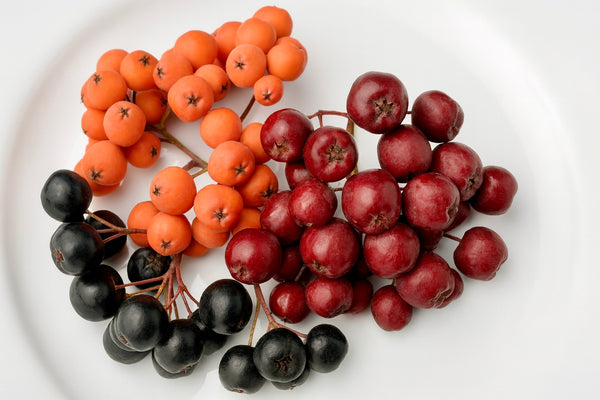
The fruits are small—about the size of a large plum—and turn yellow to warm yellow-orange when fully ripe. The flavor leans more toward sweet, aromatic pear than Mountain Ash, without the bitterness some ornamental rowans can have. When soft-ripe, the fruit has a tender, dessert-like texture that’s excellent for fresh eating but also works well in preserves, mixed fruit jams, and compotes. Ripening typically occurs in late August through September in cold regions.
Bearing, Culture & Care
Baby Shipova Pear × Mountain Ash begins fruiting quite early, often 2–3 years after planting. It thrives in half-day to full sun and prefers well-drained soils, though it tolerates a variety of soil types so long as conditions are not waterlogged. Its pest and disease resistance is generally excellent, reflecting the resilient nature of shipova hybrids. This is a low-spray, low-maintenance tree suitable for regenerative and organic systems.
Pollination & Compatibility
This tree is self-fertile, so it will reliably set fruit even if planted alone. However, yields may increase slightly with the presence of other Mountain Ash or related Sorbus species.
For growers interested in experimental breeding or pollen compatibility, Baby Shipova sits between Pyrus and Sorbus, meaning it conceptually pairs with:
Compatible Species to pair with Baby Shipova
-
Mountain Ash (bundle) — aligns with the Sorbus parentage.
-
Cold-hardy pears — align with the our hardy Pyrus parentage, including Krazulya, Krasnobokaya, Larinskaya, Luscious, Summercrisp, and Manchurian pear. The Russian pears are part European and part Ussurian, so they'll cross with Baby Shipova.
While it behaves as a standalone fruiter, these trees offer opportunities for bloom overlap, pollination synergy, and experimental hybridization for the adventurous grower.
Questions we get about Baby Shipova Pear x Mountain Ash
Does Baby Shipova Pear x Mountain Ash need a pollenizer?
It helps. Baby Shipova Pear x Mountain Ash is partially self-fertile, so it can set some fruit alone, but a second variety nearby makes crops more dependable. Baby Shipova is at least partly self-fertile and will set fruit on its own. It blooms late, with Bosc-season pears. Partners we carry include Ivan's Beauty Aronia x Mtn. Ash.
How cold hardy is Baby Shipova Pear x Mountain Ash?
We rate Baby Shipova Pear x Mountain Ash hardy to zone 3b, which means winters down to about -35°F. Our ratings come from real winters at our two Montana sites and from trusted growers across the North, not from a catalog average.
How many chill hours does Baby Shipova Pear x Mountain Ash need?
About 800 hours of winter chill (we count hours at or below 45°F), likely somewhere between 600 and 1,500. Nobody has published a chill figure for it, so that's our estimate from its relatives and origin. Our chill hours guide has a calculator for your winters, and our research page lists the sources.
What is Baby Shipova Pear x Mountain Ash good for?
Our top use scores for Baby Shipova Pear x Mountain Ash are fresh eating (7/10), jams and jellies (6/10).
What arrives, and when does Baby Shipova Pear x Mountain Ash ship?
A dormant bare-root plant, roots wrapped in moist sawdust with a vapor barrier, shipped or picked up in Missoula in spring. Sizes offered: 2-4 ft. We guarantee our plants bud out. Stone fruits can be slow, so if one still has not budded out by August 15, write to us and we credit you for the following spring.
Is Baby Shipova Pear x Mountain Ash disease resistant?
We don't know yet. Nobody has published solid disease data on Baby Shipova Pear x Mountain Ash for fire blight, so we list it as unknown instead of guessing. That doesn't mean it's weak. Plenty of the plants we grow have never been through formal disease trials. Our unusual fruit disease resistance chart has every rating, the notes and the sources.
More Plants Like This
Sold Out This Season? Try These
Pollination partners
Partners for a bigger Baby Shipova Pear x Mountain Ash crop
Baby Shipova Pear x Mountain Ash sets some fruit on its own, but a lot more with a partner. Every tree below blooms at the same time and has pollen that works for it.
Bloom group
4 of 7 (Mid)
Pollination
Partly self-fertile
Pollen
Not tested yet
See every pairing on the Pollination Charts
Baby Shipova Pear x Mountain Ash's bloom group is our best estimate. Watch it bloom and tell us what you see.
You may also like
Not available for spring 2027. Here's what we'd plant instead.
Baby Shipova Pear x Mountain Ash is off the list this season. These are in stock now, and the full shop all plants collection has the rest. Everything on our zone 3 page is rated for the same winters.
Browse the shop all plants collection for what's in stock.