
Skip to product information


Wenatchee Moorpark Apricot
$59.99
Reliable shipping
Flexible returns
Pollination
Partly self-fertile
Bloom group
5 of 7 (Mid-Late)
Ripening
Will it finish before your first hard freeze?
Check it on the Ripening Map (opens in a new tab)
Disease resistanceResists 1 of 5
- ? Bacterial canker : Unknown, no published data yet
- 4 Bacterial spot : Resistant, 4 of 5
- ? Brown rot : Unknown, no published data yet
- ? Cytospora canker : Unknown, no published data yet
- ? Shot hole : Unknown, no published data yet
Scored 1 to 5. Higher resists better, and ? means no published data yet.
See it on our apricot disease chart (opens in a new tab)At a glance: Wenatchee Moorpark Apricot is an apricot tree rated hardy to zone 4 in our ratings (winters to -30°F), and partially self-fertile, so a second variety nearby makes crops more dependable (bloom group 5 of 7, mid-late for an apricot).
| Hardy to | Zone 4 to 8. A bare number means the whole of zone 4, colder half included (winters to -30°F). Find your zone with our cold hardiness calculator. |
|---|---|
| Chill hours | About 700 hours (600 to 800). From published figures. Montana winters give it plenty. In milder climates, make sure your winters average at least this much. Check your chill hours or see our sources. |
| Pollination | Partially Self-Fertile. Bloom group 5 of 7 (mid-late), very early spring here. Sources disagree on whether it crops fully alone, so plant another later-blooming apricot such as Chinese, Harlayne, Dr 606 or Precious as a pollenizer. Nearby varieties that can boost the crop: Harlayne Apricot, Chinese Apricot, Dr 606 Apricot, Precious Apricot and 4 more. Apricot Pollination Map. |
| Rootstock and size | Lovell: full size, about 12 to 20 ft tall unpruned. Doesn't like wet feet or high-lime soil. Our rootstock guide. |
| Good for | Canning and freezing (8/10), drying (8/10), fresh eating (7/10), pies and baking (7/10), jams and jellies (7/10), sauce and butter (7/10). Scores are our own 1 to 10 ratings; 8 and up makes our Best Of lists. |
| Deer | Sometimes damaged by deer. |
| What you get | Bare root, 5-7 ft. Regular Grade or 5-7 ft. Larger & More Branching. Shipped or picked up in Missoula in spring, roots wrapped in moist sawdust. Guaranteed to bud out. |
Overview
Wenatchee Moorpark is a classic apricot cultivar best known for producing large, flavorful fruit in western climates where spring rains and frost often make apricots difficult. It’s a high-quality, “orchard style” apricot that earns its reputation in the Pacific Northwest-type pattern: cool, wet springs followed by a ripening window that can still deliver excellent eating and preserving fruit when conditions line up.
Origin & History
Wenatchee Moorpark was introduced in 1908 by C & O Nursery. It is presented in major references as a traditional apricot cultivar rather than a modern breeding-program cross with documented parentage, and it is historically associated with western Oregon and Washington as a long-time regional favorite.
Fruit & Uses
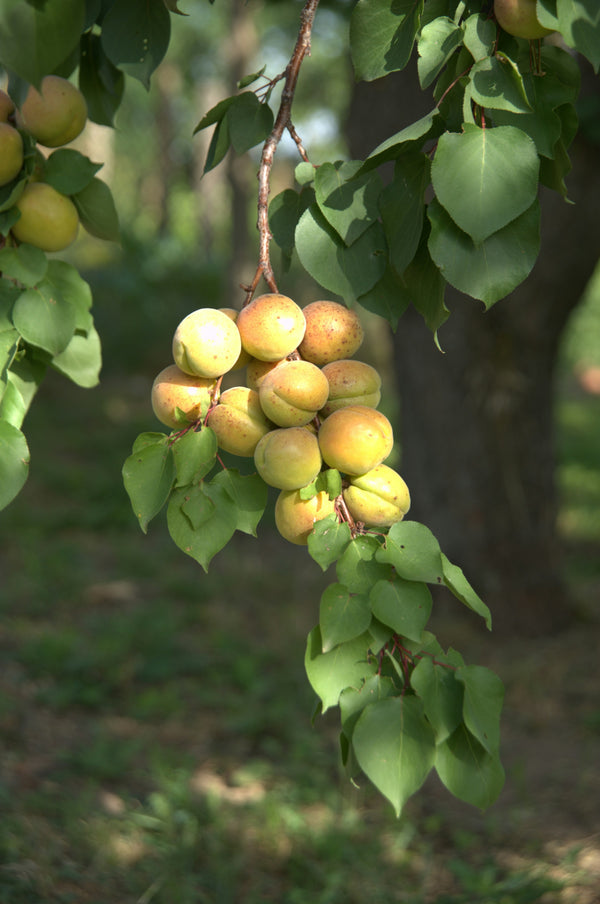
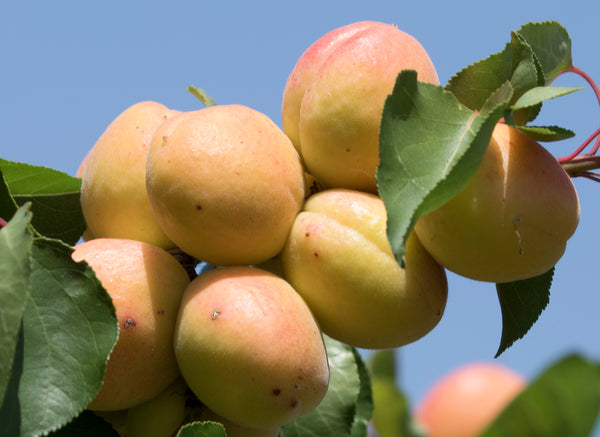
The fruits are large and oval with yellow skin and yellow-to-orange flesh. The flavor is really good and has a distinct honey sweetness to it. It isn't too sweet because it is cut with a little bit of acidity, which adds some complexity. Not as good as Zard or Robada but certainly an apricot worth growing if it can survive in your area (see cold hardiness below). Wenatchee Moorpark is commonly used fresh and is also well suited to drying, canning, and preserves—exactly the kind of apricot that becomes a “workhorse” when you can grow sweet cherries and peaches but still want a real apricot for the pantry.
Growth Habit
On full-size rootstock, Wenatchee Moorpark is capable of becoming a full-sized tree. Major references describe mature trees in the neighborhood of 20 feet with a broad spread. Early structure-building pruning is important for managing size and supporting fruiting wood, especially in climates where wet springs increase disease pressure and canopy airflow matters.
Spacing
We offer Wenatchee Moorpark on Lovell full-size rootstock. For full-size apricots on Lovell, spacing in the 15–20 foot range is a practical guideline, depending on how much you plan to prune for size control and how vigorous your site is. If you want the tree to express its full natural canopy with minimal pruning, lean wider. Even closer than 15 ft. for a smaller tree and a more intensive pruning regiment is also possible.
Pollination
Wenatchee Moorpark is self-fertile, meaning it can set fruit without a pollenizer, and is considered an excellent pollenizer for later-blooming apricots. Even with a self-fertile apricot, having another apricot nearby (such as Chinese, Harlayne, Dr. 606, Precious, or Zard) can improve consistency in years with cool, wet bloom weather.
Cold hardiness
These are apricots that are more so commercial cultivars in nature whose ancestry mainly comes from Europe. Very high quality apricots but only hardy to roughly -30F. Plant our many other hardy apricots such as Morden 604, Westcot, Debbie's Gold, Zard, and Precious if you have the potential to see temps colder than these. This cultivar should generally be limited to protected urban and warm microclimates west of the Continental Divide. They do well in Missoula and some of the warmer microclimates in Montana (near Flathead Lake, parts of the Bitterroot up on a bench, warmer parts of Plains, etc.).
Questions we get about Wenatchee Moorpark Apricot
Does Wenatchee Moorpark Apricot need a pollenizer?
It helps. Wenatchee Moorpark Apricot is partially self-fertile, so it can set some fruit alone, but a second variety nearby makes crops more dependable. Sources disagree on whether it crops fully alone, so plant another later-blooming apricot such as Chinese, Harlayne, Dr 606 or Precious as a pollenizer. Partners we carry include Harlayne Apricot, Chinese Apricot, Dr 606 Apricot.
How cold hardy is Wenatchee Moorpark Apricot?
We rate Wenatchee Moorpark Apricot hardy to zone 4, which means winters down to about -30°F. Our ratings come from real winters at our two Montana sites and from trusted growers across the North, not from a catalog average.
How many chill hours does Wenatchee Moorpark Apricot need?
About 700 hours of winter chill (we count hours at or below 45°F), likely somewhere between 600 and 800. That comes from published figures for this variety. Montana winters cover its chill easily. It's one of the less hardy apricots we carry, so winter cold matters more than chill. Our chill hours guide has a calculator for your winters, and our research page lists the sources.
How big does Wenatchee Moorpark Apricot get?
We graft Wenatchee Moorpark Apricot onto Lovell (full size), which makes a tree roughly 12 to 20 ft tall if you never prune it.
What is Wenatchee Moorpark Apricot good for?
Our top use scores for Wenatchee Moorpark Apricot are canning and freezing (8/10), drying (8/10), fresh eating (7/10), pies and baking (7/10). Anything scored 8 or higher makes our Best Of lists.
Is Wenatchee Moorpark Apricot disease resistant?
Yes, for the diseases it's been tested for. It's resistant to bacterial spot. Nobody has published solid data on it for bacterial canker, brown rot, cytospora canker and shot hole yet, so we list those as unknown. Our apricot disease resistance chart has every rating, the notes and the sources.
Will deer eat Wenatchee Moorpark Apricot?
Sometimes. Deer browse Wenatchee Moorpark Apricot now and then, so protect young plants where deer pressure is high.
What arrives, and when does Wenatchee Moorpark Apricot ship?
A dormant bare-root plant, roots wrapped in moist sawdust with a vapor barrier, shipped or picked up in Missoula in spring. Sizes offered: 5-7 ft. Regular Grade or 5-7 ft. Larger & More Branching. We guarantee our plants bud out. Stone fruits can be slow, so if one still has not budded out by August 15, write to us and we credit you for the following spring.
More Plants Like This
Sold Out This Season? Try These
Pollination partners
Partners for a bigger Wenatchee Moorpark Apricot crop
Wenatchee Moorpark Apricot sets some fruit on its own, but a lot more with a partner. Every tree below blooms at the same time and has pollen that works for it.
Bloom group
5 of 7 (Mid-Late)
Pollination
Partly self-fertile
Pollen
Good pollenizer
-
 Alice Sharp Apricot(Spring 2027)
From $44.99
-
 Corbett Apricot(Spring 2027)
From $69.99
-
 Sold out
Harlayne Apricot(Spring 2027)
-
 Sold out
Chinese Apricot

You may also like
Not available for spring 2027. Here's what we'd plant instead.
Wenatchee Moorpark Apricot is off the list this season. These are in stock now, and the full apricot trees collection has the rest. Everything on our zone 4 page is rated for the same winters.
Browse the apricot trees collection for what's in stock.